BREAKING NEWS: Volleybird Named Exclusive Renewable Distributor for North America!

Nearly 330 Million Tennis Balls & Padel Balls End Up In Landfills Each Year... and It Takes 400 Years for a Ball to Break Down!
Your Club Can Be Part of the Solution!
The Hidden Cost of "Business as Usual" Tennis & Padel Balls
Every year, hundreds of millions of tennis and padel balls are discarded. Most are made to be indestructible — combining rubber, nylon, and industrial adhesives that prevent recycling and send balls to landfills for up to 400 years.
For clubs, this isn’t just an environmental issue. It’s a missed opportunity to lead, differentiate, and align with what today’s players increasingly care about.
Renewaball was created to solve this problem — without asking clubs or players to compromise.
What Makes Renewaball Different
This isn’t repurposing. It’s full-circle manufacturing.
This isn’t repurposing. It’s full-circle manufacturing.
Renewaball is made using rubber recovered from old, used tennis and padel balls that would otherwise end up in landfills. These balls are collected, processed, and transformed into the core material for new Renewaballs, creating a true closed-loop recycling system. Instead of relying on newly sourced rubber, Renewaball gives existing materials a second life — reducing waste and lowering the overall environmental impact without sacrificing durability or playability.
This isn’t repurposing. It’s full-circle manufacturing.
Renewaball is made using rubber recovered from old, used tennis and padel balls that would otherwise end up in landfills. These balls are collected, processed, and transformed into the core material for new Renewaballs, creating a true closed-loop recycling system. Instead of relying on newly sourced rubber, Renewaball gives existing materials a second life — reducing waste and lowering the overall environmental impact without sacrificing durability or playability.
This isn’t repurposing. It’s full-circle manufacturing.
Renewaball is made using rubber recovered from old, used tennis and padel balls that would otherwise end up in landfills. These balls are collected, processed, and transformed into the core material for new Renewaballs, creating a true closed-loop recycling system. Instead of relying on newly sourced rubber, Renewaball gives existing materials a second life — reducing waste and lowering the overall environmental impact without sacrificing durability or playability.
Regular Tennis and Padel Balls Impact Climate & Environment
That's why we developed Renewaball®
Every year, hundreds of millions of tennis and padel balls are discarded. Most are made to be indestructible — combining rubber, nylon, and industrial adhesives that prevent recycling and send balls to landfills for up to 400 years.
For clubs, this isn’t just an environmental issue. It’s a missed opportunity to lead, differentiate, and align with what today’s players increasingly care about.
Renewaball was created to solve this problem — without asking clubs or players to compromise.

Players Love Us
“Switching to Renewaball was the best decision for my game and the planet. The bounce is fantastic, and I love knowing I’m making a difference.”
— Jamie L., Club Player
“I never realized tennis balls could be sustainable. Renewaball’s subscription keeps me stocked and guilt-free. Highly recommend to all players!”
— Priya S., Tennis Enthusiast
Sell Renewaball at Your Club or Company
Offering Renewaball at your club or facility is a simple way to align your operations with sustainability without compromising performance. Every club goes through thousands of balls each year, and Renewaball turns that unavoidable cost into a visible commitment to environmental responsibility. By offering a true closed-loop, recycled ball that plays at a high level, you give members and players a product they can feel good about buying… one that reduces waste while still meeting the expectations of serious play.
Just as important, Renewaball helps differentiate your facility and strengthen your brand. Sustainability is no longer a “nice to have” — it’s something players, parents, sponsors, and partners increasingly care about. Stocking Renewaball positions your club as forward-thinking and responsible, creates a natural conversation with members, and can even open the door to local PR, partnerships, and sponsorship opportunities.
You’re not just selling tennis or padel balls… you’re reinforcing your club’s values every time someone steps on court.
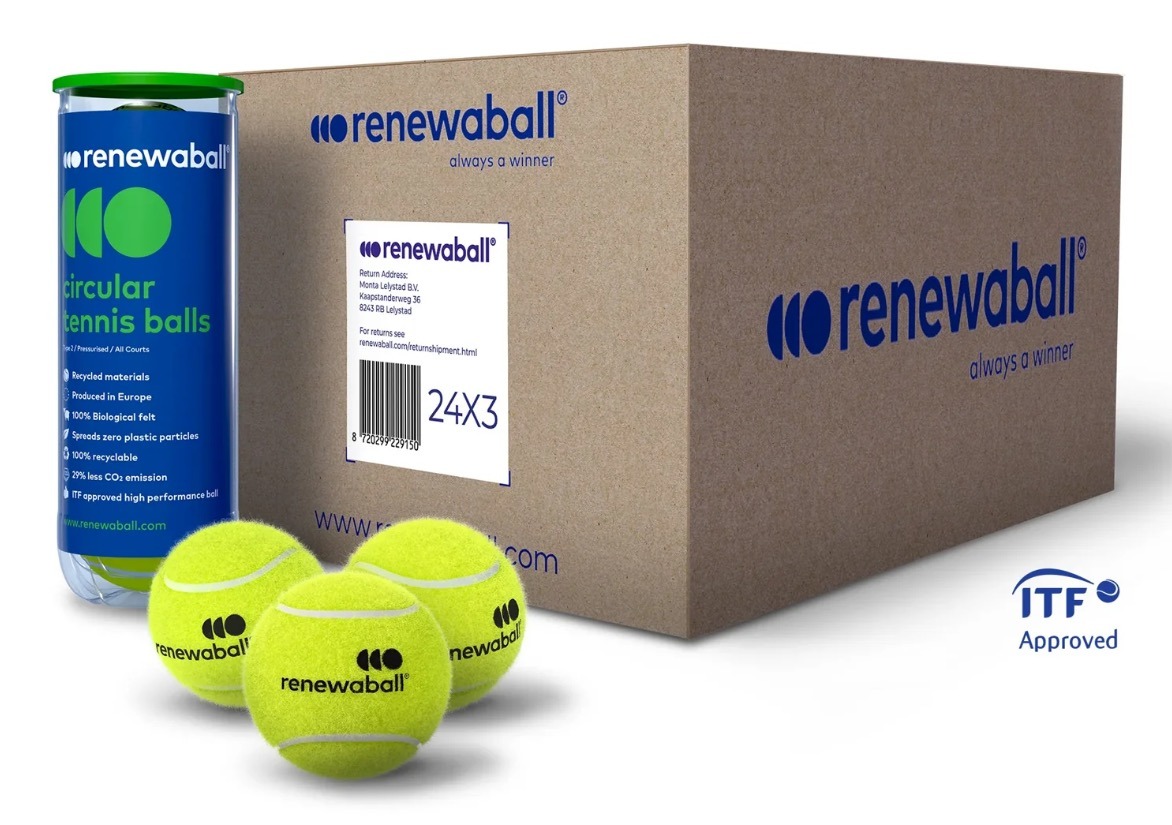
Why Choose Renewaball?

IPF Certified
International Tennis Federation Certified
You Don't Have to Switch Overnight!
The smartest clubs start strategically. Renewaball can be deployed selectively — for events, programs, or seasons — allowing clubs to test adoption, gather feedback, and expand with confidence.
- Junior Programs
- Corporate Outings
- Sustainability Weeks
- Tournaments and Special Events

Why Leading Clubs Choose Renewaball
Performance Without Compromise
Designed for real play, not just good intentions.
Future-Ready Club Positioning
Sustainability is becoming an expectation — not a trend.
Member-Visible Leadership
Small decisions send big signals about what your club stands for.
Get Started Today
Make the switch to sustainable tennis balls and padel balls. Click below to purchase your first eco-friendly package through Volleybird.shop and join the movement for greener courts.
Your Questions Answered
We would like to purchase multiple cases of balls. Is there a volume discount?
Yes. Once you submit your application and are approved for wholesale pricing, we can customize a pricing structure for your club or facility based on your volume and frequency.
Are there minimum quantities?
MOQs are typically case based. We don’t wholesale balls by the can.
Can you customize the balls with our logo?
Yes, soon you’ll be able to order custom colors and logo personalization for an additional fee. When you reach out, ask if this option is available.
Where does Renewaball get its raw materials from?
We get our feedstock from both tennis and padel players who throw their old/used balls in a Renewaball collection container, which we collect and empty when full. We separate all of them, no matter the brand, into felt and rubber. The felt is recycled (but not in Renewaball as a Renewaball does not contain polyester or nylon) and the rubber is used as raw material for new Renewaballs.
What's wrong with a 'regular' tennis ball?
Tennis and padel balls are very harmful to the environment. This is not common knowledge, not everyone realizes this, but it is really is a problem.
They are almost exclusively made in South East Asia, far from where we play tennis and padel. They are produced under working conditions that often do not match our demands.
The components of a tennis ball also come from all over the world: A tennis and padel ball has typically traveled about 80,000 km before it comes out of the package in Europe. Think of all that marine diesel, kerosene, CO2.
Wear on a tennis and padel ball consists of a trail of thousands of plastic microparticles that fly off the polyester/nylon fibre components in the felt layer. Those particles are more than likely to end up in the well-known plastic soup.
At the end of a tennis and padel ball’s life, few of them end up on a tow bar at the end of a car or in a dog’s mouth. Recycling a tennis and padel ball never fully worked: the rubber and the felt were practically inseparable. And that’s why about 97% of tennis and padel balls still end up in the garbage heap – and don’t decay. Or of course, in waste incineration. Under the felt layer is rubber and anyone who has ever seen a car tire burn knows that there is nothing nice about black rubber burning.
There are a lot of tennis and padel balls on this planet. We use over 5.5 million per year in the Netherlands alone. The US Open single-handedly spins 85,000 balls, Wimbledon 54,000, Roland Garros 65,000 and this is all per tournament!
Who are Renewaball tennis and padel balls made for?
For tennis and padel players who not only want to play with a high performance ball but also care about environmental pollution and climate change while at the same time continue playing with a good ball. As a result, working towards UN Sustainable Development Goals 12, 13, and 14.
For associations, groups, and clubs that would like to contribute to society by ensuring that balls used at their locations no longer end up in the garbage heap or the incinerator. All they have to do is place a Renewaball collection container somewhere around the club people can through their used balls in, no matter the brand. As a result, they also reduce their overall yearly waste and besides, they can of course also sell Renewaballs – making Renewaball even more circular.
But above all: Renewaballs are produced to contribute to a cleaner world and provide our own part of the solution to the serious climate problems that exist today.
Are the Renewaball tennis and padel balls gas-pressurized?
Yes. Gas-filled and suitable for all types of courts. Packed in a 100% recyclable pressurized tube.
How do they play?
Renewaball has asked this question to a few good tennis players, including professinal trainers and players.
Their feedback is as follows: a nice lively ball, fast, a fraction lighter (about 2 grams) than the balls we usually play with, which are a bit stiffer. Soft on the strings, good touch. Plays comfortably and is nice and durable.
The fact that it is a little lighter (within ITF standards of course) would reduce the risk of injury.
The Renewaball padel balls last about twice as long as any other padel ball due to their felt being woven, not punched. We also get fed back that one can smash this ball really well and play it outside the court.
Are the Renewaball Padel balls IPF approved?
Yes. The Renewaball padel ball is certified by the International Padel Federation (IPF) for professional use.
Where are the Renewaballs for sale?
Volleybird.shop is now the exclusive distributor of Renewaball for North America.
CLICK HERE for retail orders in canisters of three balls each.
CLICK HERE to inquire about wholesale pricing and offering Renewaball at your club or facility.
Is there no plastic in a Renewaball at all?
No. What is in them: Natural rubber and synthetic rubber. The felt layer is made of sheep wool from English and Norwegian sheep – and a tiny bit of cotton.
Are the Renewaballs made from 100% used tennis balls?
No, 100% is not possible, that is not feasible. This is how it works:
First the felt. The felt layer of a Renewaball is made of wool with a little cotton. We can recognize this felt layer during collection and reuse it. But the felt layer of ‘normal’ balls is made of wool and nylon/polyester. We reuse that – but not for the Renewaball because it has an organic felt layer. By the way: the 100% organic felt of the Renewaball is woven in a felt factory where a lot of ‘normal’ tennis ball felt is made, with wool, nylon, and polyester. This means that in theory, our biological felt could contain traces of nylon or polyester.
Then the rubber, by far the main part of a tennis and padel ball. The percentage of the Renewaball that is made from old balls is now 25% but ever increasing; however, it will always have to contain some ‘virgin rubber.’
Based on rapidly advancing proprietary technology, Renewaball is increasingly able to identify old, worn balls by brand and ball type. This is necessary to know what the ‘ingredients’ of each specific ball are – and what still needs to be added to make it a real Renewaball. We expect it’ll take about a year and a half to substantially raise the used-rubber percentage. But it does cap off; as mentioned before there will always be some ‘virgin rubber’ and some other components.
But every Renewaball is 100% recyclable!
Do the Renewaballs have disadvantages?
Yes, we have been able to discover one so far. Our felt is made entirely of wool, this was the case for all tennis balls until sometime in the early 1960s.
Wool plays well, it is durable, and biodegradable. The felt of every other tennis ball brand also contains nylon/polyester. This absorbs less moisture than wool. So, on a wet outdoor court, the Renewaball may become a little bit slower than a ‘normal’ ball.
If tennis and padel balls are so bad for the environment, why has it taken so long to come up with a more sustainable option?
We do not know why other brands have not come up with this kind of innovation before; however, this is what we do know: To make a tennis or padel ball from used tennis or padel balls, you need to collect used balls. That is quite a logistical operation, particularly when set up internationally and on a longer term basis.
You then have to separate the rubber and felt from those collected balls. Until recently, there was no solution: both materials are very glued together and can hardly be pulled apart properly. Renewaball has recently mastered this process well and it was this particular innovation, among other things, that opened the door to the first circular tennis ball – and that is Renewaball.
Are Renewaballs more expensive than the balls I normally play with?
Renewaballs tennis balls are not more expensive. First of all, it is simply within the price range of ‘normal’ tennis and padel balls. Renewaball padel balls are slightly more expensive due to the felt quality we use. But then they last twice as long.
However, due to their environmental footprint, regular tennis and padel balls you are used to playing with, do impose part of the real cost to subsequent generations. ‘Normal’ balls carry a negative externality with a negative social cost to society, which is reflected in non of their prices.
Wouldn't it be better if every brand of tennis and/or padel balls supplied a circular ball?
So far, Renewaball is the only one to do so. However, every brand can contribute. Through collaboration with such another brand, Renewaball can ensure that we can pick out those balls after collection (brand / type). As we know which type of ball we are dealing with during collection, we also know exactly which ingredients will come out of that ball when we separate it into rubber and felt. This way, we can turn a specific brand ball into a Renewaball of the same brand. We are open to working with other brands, not just keeping the technology to ourselves.
What is important about Renewaball's B Corp Certification?
B Corp Certification is a designation that a business is meeting high standards of verified performance, accountability, and transparency on factors from employee benefits and charitable giving to supply chain practices and input materials.
As leaders in the movement for economic systems change, B Corps reap remarkable benefits. They build trust with consumers, communities, and suppliers; attract and retain employees; and draw mission-aligned investors. As they are required to undergo the verification process every three years in order to recertify, B Corps are by definition also focused on continuous improvement, leading to their long-term resiliency.
If tennis and padel balls are so bad for the environment, why has it taken so long to come up with a more sustainable option?
We do not know why other brands have not come up with this kind of innovation before; however, this is what we do know: To make a tennis or padel ball from used tennis or padel balls, you need to collect used balls. That is quite a logistical operation, particularly when set up internationally and on a longer term basis.
You then have to separate the rubber and felt from those collected balls. Until recently, there was no solution: both materials are very glued together and can hardly be pulled apart properly. Renewaball has recently mastered this process well and it was this particular innovation, among other things, that opened the door to the first circular tennis ball – and that is Renewaball.
- Privacy Policy
- Terms
- Contact
© 2025 Renewaball. All rights reserved.